

Black ceilings sound like a big risk. You picture a dark cave, not a cozy room. But that fear is usually wrong, and the right room can look better with a black ceiling than it ever did with white.
Black ceiling paint works best when your ceiling has strong architecture, exposed pipes or ductwork you want to hide, or a room that feels too tall and empty. Keep reading and you’ll know exactly when is black ceiling paint the right choice for your own space, plus the shades, finishes, and steps that make it actually look good instead of like a mistake.
Table of Contents
ToggleQuick Answer: When is Black Ceiling Paint the Right Choice?
A black ceiling is the right choice when a room meets at least one of these specific criteria:
- The vertical space is disproportionately high (10+ feet) and feels sterile or cold.
- The ceiling is packed with visible utilities, like an unfinished basement ceiling painted black to hide ductwork.
- The room has architectural framing elements, such as white coffered beams or deep crown molding, that need heavy contrast.
- The space serves a specific visual function, like a dedicated home theater, media room, or a bedroom with black ceilings where light control is desired.
To avoid a claustrophobic result, the room must have ample natural or layered artificial lighting, and the walls should remain a lighter contrast color to balance the heavy visual weight above.
The Strategic Logic of Dark Ceilings
To understand why black paint works, you have to look at the physics of light. White surfaces have a high Light Reflectance Value (LRV), bouncing light around a room to make boundaries feel distant. True black paints have an LRV near zero. They absorb almost all available light.
When you apply a zero-reflectance coating above you, the ceiling surface visually recedes or drops, depending on how the surrounding walls are treated. This effect allows you to solve specific spatial layout problems that traditional white primers cannot fix.
If You Have High Ceilings but Want a Cozy Space

Tall ceilings look great in photos. Day to day, they can make a room feel empty and hard to heat up, both in temperature and in mood. A white ceiling pushes your eye up and out, which makes the room feel bigger but also less personal.
Paint that same ceiling black and the effect flips. The ceiling seems to drop down closer to you. The room feels wrapped instead of open. This works well in living rooms, dens, and bedrooms with ceilings over nine feet.
A deep, true black like Sherwin-Williams Tricorn Black or Benjamin Moore Onyx does this well. Both hold their color under regular light and don’t shift green or blue the way some cheaper blacks do.
Table of Contents
If You Want Something Special in Your Design
A black ceiling can act like a border on a rug. It marks out a space without adding a wall. This works well in open floor plans, where you want to separate a dining area from a living area but don’t want to lose square footage to a partition.
Keep your furniture and walls light when you go this route. Black on top and pale on the bottom reads as intentional. Black on top with dark walls and dark furniture just reads as a dark room.
Bedrooms with black ceilings often use this trick too. A black ceiling paired with warm wood tones and soft bedding turns a plain bedroom into something that feels like a boutique hotel room, not a basement.
If Your Space Has Geometric Designs
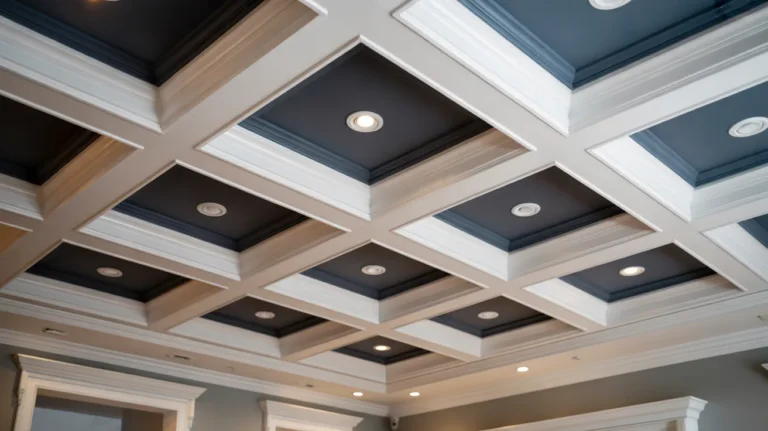
If your ceiling has beams, coffered panels, or crown molding, black paint is one of the best tools you have. Paint the flat sections between beams black and leave the beams themselves white or natural wood, and the shapes pop out at you.
The same trick works on cathedral ceilings and barrel-vault ceilings. The black recedes into shadow while the white trim catches the light, so the architecture reads clearly from across the room. This is a case where paint does the work that expensive millwork usually does.
If You Want to Hide Anything on the Ceiling
This is the most practical reason people choose a black painted ceiling, and it’s the one we get asked about most on job sites. If you have exposed pipes, ductwork, wiring, or an old patch job on the ceiling, black paint makes all of it disappear into shadow instead of drawing the eye.
This is exactly why black ceilings in basement projects are so common. Basements often have low ceilings packed with mechanical stuff you can’t move. Paint the ceiling, the ducts, and any visible pipes the same flat black, and the eye stops trying to sort out what’s what. A basement ceiling painted black also hides water stains and old drywall patches better than any lighter color.
Restaurants and retail shops use the same trick for a reason. It hides the guts of the building and gives the space an industrial look without spending money on a real remodel.
Does a Black Ceiling Make a Room Look Bigger?
Usually not, and you should know that going in. Black ceilings tend to make a room feel more intimate, not larger. If your goal is a room that feels bigger and brighter, skip black and stick with white or a pale color.
Where black ceilings do help is in rooms that already feel too big, too tall, or too impersonal. In those spaces, black brings the scale down to something that feels human. Think of it as trading square footage on paper for comfort in real life. Most homeowners who try it are chasing that trade, not extra space.
One more honest note on light. A black ceiling absorbs light instead of bouncing it around the room. If your room only has one small window, add extra lighting before you commit, or the space can feel gloomy after dark.
How to Choose the Right Shade of Black
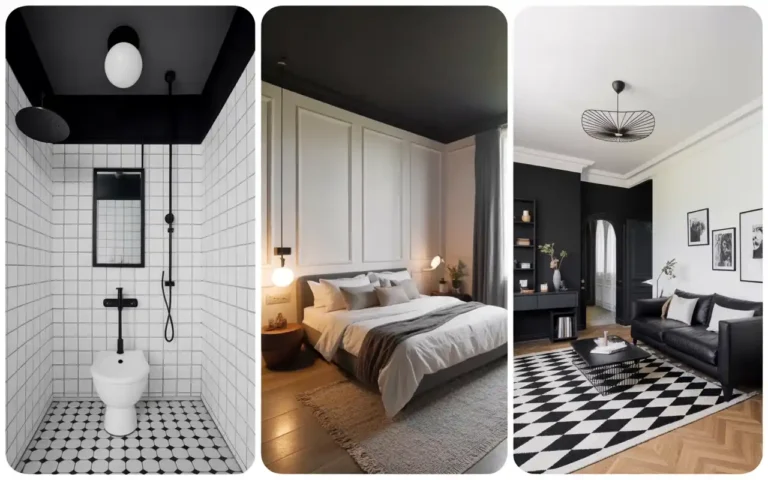
Not every black paint for the ceiling looks the same once it’s on your wall. Some blacks lean warm and brown. Others lean cool and blue. Under regular bulbs, cheap blacks can look muddy gray instead of black.
Test a sample on an actual section of your ceiling, not just a wall, since ceilings catch light differently. Look at it in the morning, at midday, and after dark with your lamps on. A shade that looks perfect at noon can look flat and gray at night.
For a true, deep black, Sherwin-Williams Tricorn Black and Benjamin Moore Black are both reliable picks that hold their tone. If you want something slightly softer, Benjamin Moore Wrought Iron gives you a near-black charcoal that’s more forgiving in smaller rooms.
Matte, Satin, or Eggshell: Picking the Right Finish
Sheen matters as much as the color itself. Matte finish hides flaws and doesn’t bounce light, which is why most black ceilings use it. It gives you that flat, shadow-like look.
Satin or eggshell adds a slight shine. That shine can look great in a bathroom or kitchen ceiling since it resists moisture better, but it also shows every roller mark and ceiling texture bump. If your ceiling has popcorn texture or old patches, stick with matte. It forgives more than any other finish.
Practical Tips for Painting Your Ceiling Black
Black paint needs more coats than lighter colors, plain and simple. Budget for two full coats minimum, sometimes three if you’re painting over white.
Tint your primer gray before you start. A plain white primer under black paint means you’ll need an extra coat just to get full coverage. A gray-tinted primer cuts that down and saves you real money on paint.
Cut in the edges carefully where the ceiling meets the wall. Black shows sloppy lines far more than white does, since there’s no room for the eye to forgive a wobble.
If your ceiling has any texture, use a thicker nap roller to get into every dip and ridge. Missed spots show up as small gray patches once the paint dries, especially under daylight.
Get Started on Your Black Ceiling Paint Project
A black ceiling is a bigger commitment than most paint colors, both in prep work and in the final look. Getting the shade, sheen, and coverage right on the first try makes the difference between a room that looks designed and one that looks like a mistake.
If you’re in San Diego and want this done right the first time, San Diego Custom Painting handles projects like this every week, from basement ceilings to full media rooms. Our interior painting services in San Diego cover everything from color testing on your actual ceiling to full prep and application, so you’re not guessing which black will work in your space. Call us or request a free estimate and we’ll walk your room with you before you commit to a color.
Conclusion
A black ceiling isn’t the right pick for every room, but for the right one, it’s one of the best design moves you can make. High ceilings, exposed pipes, strong architecture, or a room that needs some warmth are all good reasons to consider it. Test your shade first, get the finish right, and don’t skip the extra coats. That’s really what separates a great black ceiling from a flat, muddy one.
FAQs About Black Ceiling Paint
Will a black ceiling make my room feel smaller?
It can make a room feel cozier and more closed in, especially in smaller spaces. It won’t shrink the actual size, but it changes how the room feels day to day.
Is a black ceiling a bad idea for resale value?
It depends on the buyer and the room. A black ceiling in a media room or dining room is usually seen as a design choice. A black ceiling in every bedroom of the house can turn off buyers who want a neutral, move-in-ready look.
How much does it cost to paint a ceiling black?
Most homeowners pay more than they would for a standard white ceiling, mainly due to the extra coats black paint needed. Get a quote based on your ceiling size and current color, since older ceilings with texture or stains often need extra prep.
Can I paint just part of my ceiling black?
Yes. This is common in open floor plans, where painting one section black marks off a dining area or reading nook without adding a wall.
What color should my walls be if my ceiling is black?
Light and neutral walls work best. White, soft gray, or warm beige let the black ceiling stand out without making the whole room feel dark.
Does a black ceiling need extra coats of paint?
Yes, almost always. Black paint has less pigment coverage per coat than lighter colors, so two coats is the minimum and three is common over a white ceiling.