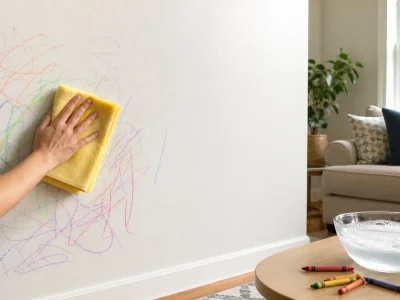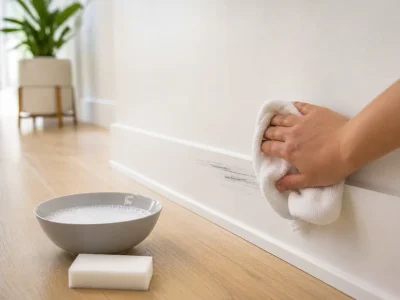

Scuff marks are everywhere, and they have a way of appearing just where you least expect them. On fresh paint, they can detract from a job’s appearance long after the paint has dried and cured. From black scuff marks on hallway walls to scratches along the baseboards, these commonplace annoyances have the ability to completely ruin the appearance of your clean home.
The good news is that many of these marks can be easily cleaned using common household solvents, but only if you know what to do and how to properly clean scuff marks off walls of different paint finishes.
Table of Contents
ToggleKnowing how to get scuff marks off walls can save you a lot of time and frustration when you are trying to regain the beauty of your home. The hard part is knowing how to clean scuff marks from walls without pulling the paint off and damaging the finish. The key is knowing what to do to rid yourself of the various kinds of scuff marks depending on the kind of mark and how it was made.
In this article, we will teach you how to clean scuff marks from walls and how to remove stubborn marks that are particularly challenging to get rid of. We will also share a few errors to avoid and tell you when it is the right time to repaint if repainting is your only option.
What Causes Scuff Marks on Walls?
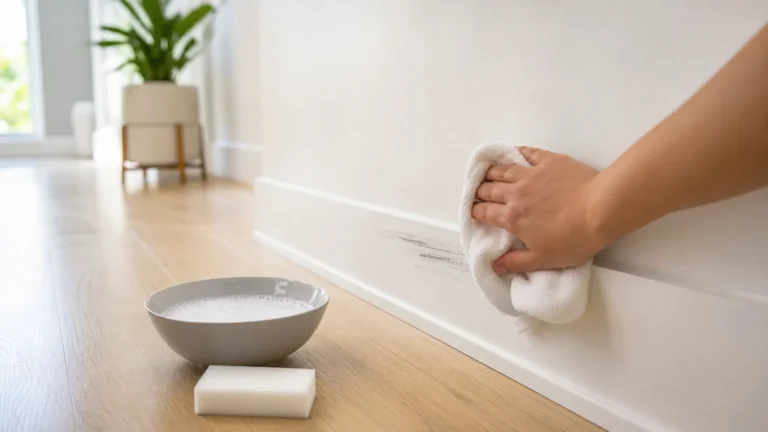
Have you ever thought about why your walls are covered in annoying marks? Well, here’s what we see: dark patches and streaks show up from shoes, furniture, bags, toys, and even brooms and mops bumping against your wall. Rubber soles? Worst offenders of all, especially if your walls happen to be white or light-colored—dark smudges look extra obvious on a white surface.
Hold on a second. Is every scuff the same? No, they’re not! The scuff might be something you can remove by wiping or may be just showing a scratch underneath. A quick way to tell is to wipe the mark lightly: if it fades, it is surface dirt, and if it stays, it is probably a scratch in the paint.
What’s making those mysterious marks? Shoes—rubber soles mean you’re leaving dark streaks by the front door, at the bottom of stairs, or along baseboards. Imagine furniture being dragged along the wall—chairs, tables, and even sofas can cause streaks when they’re pushed against it.
Can backpacks, briefcases, satchels, and purses be responsible for leaving dirt or dye on the wall? Kids’ toys and sporting equipment, for heaven’s sake, not to mention animals, all add their contribution of scuffs to busy rooms.
How to Get Scuff Marks Off Walls Without Damaging Paint
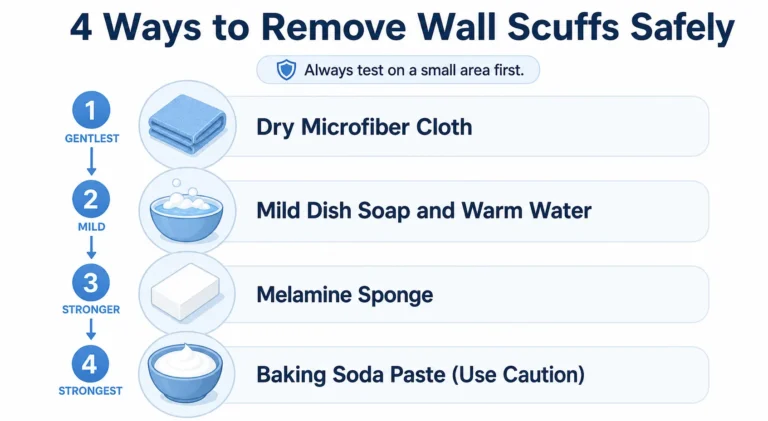
The best solution would be to proceed from a low-impact method to stronger methods. Never fail to test on a tiny section of the wall before removing the whole stain with the selected method. Be extra careful with the paint finish and condition of your walls if you opt to treat vintage décor or a fragile matte finish.
1. Wipe the Wall With a Dry Microfiber Cloth
This is going to be the most delicate way to get rid of a little light scratch or residue mark on the surface. Grab your microfiber towel and very lightly wipe around the area that you’re trying to clean to pick up any residue from tight spots. Just don’t press hard enough to scratch the surface of the paint.
Once the scuff is gone, take a second to clean up the lint that gathered on the wall surface. Do not attempt this with deep scratches, as this method is only suitable for fresh, light marks. It is suggested to use a microfiber cloth if you have bumpy or textured walls.
2. Clean With Mild Dish Soap and Warm Water
What if dry wipe cleaning won’t cut it? Add a few drops of mild dish soap to a bowl of lukewarm water, soak a soft sponge or microfiber cloth in the solution, and wring it out so it’s only damp. Proceed to wipe away the mark with up-and-down gentle motions to prevent the walls from getting additional markings.
After having cleaned the surface using the soap cleaner and a soft cloth, wipe off the surface once again with a clean, damp cloth to eliminate all traces of the product. You can then dry the surface with a soft towel. Note that this method is to be used exclusively on walls with washable paint. A soft matte or flat surface may be sensitive to moisture retention, which risks showing new traces.
3. Try a Melamine Sponge on Stubborn Marks
If ordinary rubbing doesn’t work, a more modern solution is available in the form of a melamine eraser that can be used to remove stubborn rubber marks from walls. To begin with, test this method on a small area by lightly wiping just one mark with a damp sponge.
Note that a melamine sponge is mildly abrasive and can dull the surface of the paint. It is thus preferable to turn to these tools only if the paint layer is very resistant.
4. Use Baking Soda With Caution
A clean surface can be obtained by lightly rubbing the wall with a paste of baking soda and water. This technique is to be used for stubborn stains that have been pressed deep into the paint surface, but the grittiness of the baking soda could be detrimental to the thin layer of paint.
If you are brave enough to try this method, go ahead and dip a small portion of the cloth into the baking soda and water mixture. Remember to wipe off the entire abrasive solution using a clean cloth so that there’s no chance of any residue being left on the wall. This technique shouldn’t be used on fragile matte paint either.
If this method is applied to a wall with a rough surface, do not use slow, aggressive motions. Wipe the surface lightly in circles with a paper towel or cloth. Don’t waste your time and energy rubbing if the mark won’t budge; extra scrubbing can damage a larger area of paint, which will be much more difficult to fix than a small stain.
Choose the Right Cleaning Method for Your Paint Finish
Have you ever puzzled over why some walls wash right off in easy wipe-downs while others tend to grab onto every smudge? Turns out the answer depends on the kind of paint you’ve got—the one that’s willing to stand up to vigorous cleaning—or not. Before you start scrubbing, take a look at our paint cleaning chart below.
Paint finish | Best starting method | Main precaution |
Flat or matte | Dry microfiber cloth | Avoid vigorous rubbing and abrasive sponges |
Eggshell | Soft cloth with mild soapy water | Test moisture and pressure first |
Satin | Damp microfiber cloth | Avoid harsh chemicals |
Semi-gloss | Mild detergent and a soft cloth | Do not use abrasive pads |
High-gloss | Soft cloth with diluted mild soap | Protect the smooth, shiny finish from scratches |
And how well will your paint hold up to cleaning? Depends on the brand, the formula, the age of it, and the application! Think about a washable matte that doesn’t look like your average flat. Read the brand’s cleaning instructions!
Common Mistakes to Avoid When Cleaning Wall Scuffs
Incorrect cleaning methods can leave scratches around small marks and may lead to larger repairs. There are some cleaning chemicals that are safe to use in the home but are not suitable for use on painted surfaces.
To save yourself from potential wall scuff cleaning errors, keep these in mind: overly abrasive scrubbing could leave the paint with little to no shine. Using far too harsh chemicals could stain the paint or damage the finish. Dirty sponges will also spread contamination across the wall surface and could potentially enlarge the wall scuff mark.
For more regular scuffs, a small amount of soap and a damp cloth will normally do the trick. If you see the paint coming away, it’s best to stop cleaning altogether rather than trying to scrub the dirt away.
When Should You Repaint Instead of Cleaning?
Cleaning is not the answer to every wall finish problem. If marks will not rub away with a soft cloth or sponge, the paint itself has been marked, scratched, or abraded. And of course, the more you clean them, the more they get marked!
A paint touch-up is recommended when the area has peeling paint, scratches, primer showing through, heavy staining, or is obviously uneven after cleaning. If damage is minimal, touch-up can be limited to the damaged spot. Visible differences after spot painting are often caused by faded paint or uneven sheen.
In order to obtain a better finish, it may be necessary to lightly abrade the surface and use a suitable primer before repainting. If your home was built before 1978, follow the EPA’s lead-safe guidance before sanding or scraping any old paint. However, if there are many blemishes over a large surface, a completely repainted wall will look more uniform.
A skilled painter will be able to examine the finish and advise on the ideal preparation and whether simply “topping up” the finish or a full repaint will be the best option. It’s probably worth paying for that expertise to prevent further repairs after a bad match.
Conclusion
Knowing how to get rid of common marks might help keep the home feeling fresh without needing to repaint. It is understood that, in the majority of cases, a microfiber towel or soap and water should be adequate to remove surface marks. More stubborn marks require even more thorough cleaning, while damaged paint might need a total repaint.
Always use the mildest effective technique, test on a small section before cleaning a larger area, and stop if the paint starts to change. Proper maintenance and prompt repairs can help prolong the life of painted walls and keep the home looking nice.
For damaged, heavily marked, or uneven walls, call on SD Custom Painting’s expertise and experience to discuss the best paint options.
FAQs
Can I remove scuff marks from matte paint?
Yes, but matte paint is delicate, and cleaning it can cause more scratches or stain damage than other finishes. Use a dry cloth to clean and avoid abrasive cloth.
Should I repaint a wall if I cannot remove the scuff?
Yes, if the scuff will not come off with gentle cleaning, the paint itself is probably marked. If the coating is scratched, gouged, or has lost color, then touch-up paint or new paint is in order.
At what point should I call in a professional painter?
Call a professional when the wall is heavily stained, the paint looks different after cleanup, or the scratches and stains can’t be fixed with a touch-up. In these cases, it’s best to seek professional advice on how to best repair.
Will vinegar take off scuff marks?
It may be able to do some of this, but most of your regular scuffs won’t even need diluted vinegar. Nearly any mild soap and water combination will work much better for your painted walls.