
You’ve picked the perfect color. Now you’re standing in the store wondering how many gallons to grab. Buying too little means a mid-job store run. Buying too much means wasted money sitting in your garage.
How much does a gallon of paint cover? You are likely looking for a quick answer to get your project started right now. On a smooth, primed interior wall, one gallon covers 350 to 400 square feet per coat. But real walls aren’t usually smooth, and that figure changes depending on the type of surface, the quality of the paint, and how many coats you put on. This guide has all the numbers, math, and useful recommendations you need to make the proper purchase the first time.
Table of Contents
ToggleKey Takeaways
- One gallon of wall paint covers 350 to 400 square feet on a smooth surface.
- Most rooms need two coats, which cuts that number to 175 to 200 square feet per gallon.
- Textured walls, bare drywall, and dark colors all reduce coverage by 20 to 30 percent.
- Always buy 10 percent extra for touch-ups and waste.
- A 5-gallon bucket covers 1,750 to 2,000 square feet with one coat.
Why Is Accurate Paint Coverage Important?
It’s a major problem when you run out of paint in the middle of a wall. Even if the color code is the same, a new batch may dry a little differently. You get patches that are easy to see and need to be painted over.
It’s a waste of money to buy too much. A gallon of good paint costs between $30 and $80. Paint that is left over and stored in a garage separates, peels over, and is normally thrown away after one or two years.
If you get your estimate right, you’ll get one batch of paint, the same color, and no extra fees. It also helps you figure out how much money you need to spend before you start.
What Is the Standard Coverage for a Gallon of Paint?
One gallon of paint covers 350 to 400 square feet on a smooth, primed wall. This is the number printed on the label and assumes ideal conditions. Real-world coverage is often lower due to texture, porosity, and application method.
Here is the standard paint coverage per gallon by paint type:
Paint Type | Coverage Per Gallon |
Wall Paint | 375 to 425 sq ft |
Trim Paint | 375 to 425 sq ft |
Ceiling Paint | 350 to 400 sq ft |
Primer | 225 to 275 sq ft |
Because the primer soaks into the surface instead of lying on top, it covers much less. Get more primer than you think you’ll need.
How Many Square Feet Does a Gallon of Paint Cover?
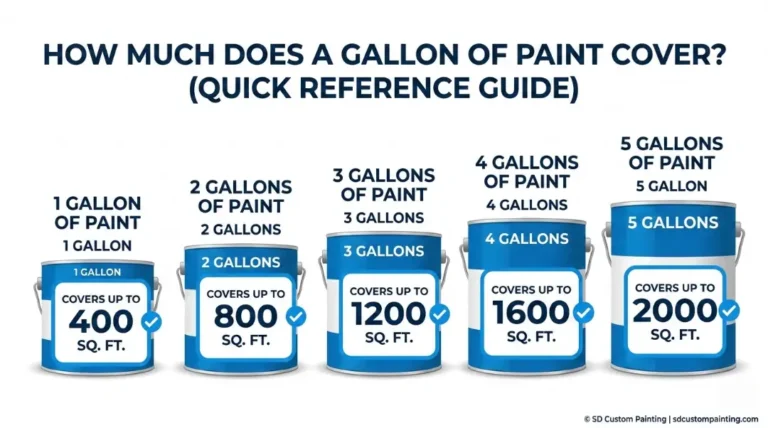
One gallon of paint covers about 350 to 400 square feet, which is roughly the size of a standard two-car garage. For a typical small bedroom or a large bathroom, this amount is usually enough to apply two full coats. When you are calculating for a larger space, you should plan for one gallon for every 200 square feet of actual floor space.
The answer changes depending on how many coats you apply. Most projects need two coats for a professional finish.
Gallons | One Coat | Two Coats |
1 gallon | 350 to 400 sq ft | 175 to 200 sq ft |
2 gallons | 700 to 800 sq ft | 350 to 400 sq ft |
3 gallons | 1,050 to 1,200 sq ft | 525 to 600 sq ft |
4 gallons | 1,400 to 1,600 sq ft | 700 to 800 sq ft |
5 gallons | 1,750 to 2,000 sq ft | 875 to 1,000 sq ft |
Two gallons will cover an ordinary bedroom or living room with two coats. Four gallons is enough for a big, huge room or a few rooms that are connected. Buying five separate gallons costs $175 to $300, but a 5-gallon bucket costs $150 to $250.
Real Room Example
A 12 by 14 foot bedroom with 9-foot ceilings:
- Total wall area: (12 + 14 + 12 + 14) x 9 = 468 square feet
- Subtract one door (20 sq ft) and two windows (30 sq ft): 418 square feet
- Two coats: 418 x 2 = 836 square feet
- Gallons needed: 836 / 375 = 2.23 gallons
- Buy 3 gallons to be safe
Special Circumstances That Impact Paint Coverage

Textured Walls and Rough Surfaces
Textured walls have more surface area than flat walls. Paint fills all those bumps and ridges, so you use more of it. Reduce your expected coverage by 20 to 30 percent for these surfaces:
- Stucco: 250 to 300 square feet per gallon
- Brick: 250 to 300 square feet per gallon
- Popcorn ceilings: 270 to 300 square feet per gallon
- Heavy orange peel texture: 310 to 330 square feet per gallon
For a textured wall, the rule is simple. If your smooth-wall math says 3 gallons, buy 4.
Fresh or Bare Drywall
Fresh drywall is very porous. It soaks up paint fast. Without primer, you could need three or even four coats of paint just to get solid coverage. Always apply two coats of primer before painting bare drywall. Use a high-build primer for patched or repaired surfaces.
Dramatic Color Changes
Covering a dark wall with a light color is one of the hardest paint jobs. Light colors, especially whites and pastels, have less pigment density. Going from navy blue to white can take three or four coats. A gray-tinted primer applied first cuts this down to two coats of topcoat. This saves you one to two gallons on a single room.
Lighter colors also cover less well over any surface. If you are painting with a light color over a medium tone, add at least one extra coat to your estimate.
Interior vs. Exterior Painting
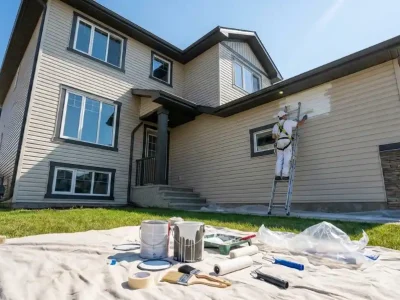
Exterior surfaces face more challenges. Weathered wood, stucco, and masonry are porous and rough. Exterior paint coverage often drops to 250 to 350 square feet per gallon. A typical 1,500 square foot exterior stucco home needs 12 to 15 gallons for two coats. Exterior primer covers even less, around 200 to 250 square feet per gallon, because the surface soaks it up.
How Paint Finish Affects Coverage
The finish type changes how paint spreads and how many coats you need.
- Flat and matte finishes are thicker and hide surface imperfections well. They give the best coverage at 375 to 425 square feet per gallon. Best for ceilings and low-traffic walls.
- Eggshell and satin finishes are slightly thinner but more durable. Coverage runs 350 to 400 square feet per gallon. These are the most popular choice for living rooms and bedrooms because they clean up well.
- Semi-gloss and high-gloss finishes are thinner and more reflective. They cover 325 to 375 square feet per gallon. They highlight imperfections on walls but are ideal for trim, doors, and cabinets where durability matters more than hiding power.
Does Paint Quality Affect Coverage?
Yes, it makes a real difference. Premium paints contain more pigment, better resins and binders, and a higher volume of solids. This means more color on the wall with each coat.
A key ingredient is titanium dioxide. Paint with higher titanium dioxide content provides better opacity, meaning better hide power. Premium paints use more of it.
Paint Tier | Price Per Gallon | Coverage | Coats Needed |
Budget brands | $25 to $35 | 300 to 350 sq ft | 3 coats |
Mid-range | $40 to $55 | 350 to 375 sq ft | 2 to 3 coats |
Premium (Sherwin-Williams Duration, Benjamin Moore Regal Select) | $55 to $80 | 375 to 425 sq ft | 2 coats |
Budget paint looks cheaper upfront. But three coats of a $30 paint costs $90 in materials. Two coats of a $65 paint costs $130. The premium option costs $40 more but takes less time and gives a better finish that lasts 5 to 7 years instead of 3 to 4.
Quart vs. Gallon: Which Should You Buy?
A quart covers about 90 to 100 square feet. It costs roughly half the price of a gallon. For touch-ups or small accent walls, a quart makes sense.
For any room or project larger than 100 square feet, always buy gallons. You save money per square foot and reduce the risk of a color mismatch between containers. One important rule: buy all gallons from the same batch code. Paint companies cannot guarantee a perfect match between different production runs of the same color.
How to Calculate How Much Paint to Buy
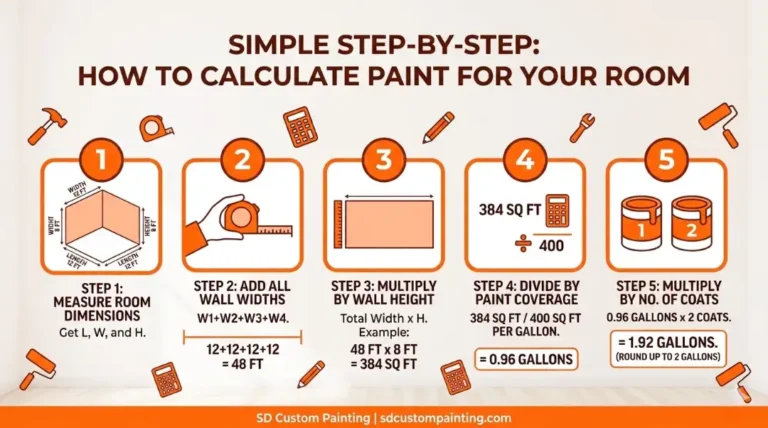
Follow these five steps for any room:
Step 1: Measure each wall. Multiply width by height for each wall. Write down each number.
Step 2: Add all wall areas together. This is your total wall surface area.
Step 3: Subtract doors and windows. Use 20 square feet per door and 15 square feet per average window.
Step 4: Multiply by number of coats. For two coats, multiply your total by 2.
Step 5: Divide by 350. Using 350 as your coverage rate builds in a safety buffer. Round up to the next full gallon. Then add 10 percent for touch-ups.
Quick Example: Living Room
- Four walls: 15 x 9 (x2) and 18 x 9 (x2) = 594 square feet
- Subtract 2 windows and 1 door = 50 square feet
- Paintable area: 544 square feet
- Two coats: 544 x 2 = 1,088 square feet
- Gallons: 1,088 / 350 = 3.1 gallons
- Buy 4 gallons
You can also use a free online paint calculator from Sherwin-Williams or Benjamin Moore. These tools handle the math instantly. Always verify the result by hand for larger projects.
Tips for Maximizing Paint Coverage
To get the most out of every drop, your application technique must be precise. Using the right tools is the best way to ensure the paint goes exactly where it belongs.
- Prime first. A tinted primer costs $25 to $35 per gallon. It creates a uniform base so your topcoat goes on in two coats instead of three. On a large project, this saves two or more gallons of expensive finish paint.
- Use the right roller. A 9-inch roller with a 3/8-inch nap works best on smooth walls. For textured surfaces, use a 1/2-inch nap. A quality roller from brands like Purdy applies paint more evenly and uses 15 to 20 percent less paint than a cheap roller.
- Do not overload your roller. Load it, then roll off excess in the tray. This prevents drips and gives a more even coat.
- Keep a wet edge. Work in sections and do not let paint dry between them. Dried overlaps create lap marks that require extra coats to fix.
- Control temperature and humidity. Paint at 50 to 85 degrees Fahrenheit with moderate humidity. Hot or dry conditions cause paint to dry too fast, forcing more coats to achieve even coverage. Allow proper recoat time between coats, usually 2 to 4 hours for latex paint.
- Buy everything at once. Get all gallons from the same store visit. This guarantees the same batch code and eliminates color variation risk.
Looking for a San Diego Painting Company? Call Us at SD Custom Painting!
If you want perfect coverage without the guesswork, our team at San Diego Custom Painting handles all the calculations for you. We provide professional interior and exterior painting services in San Diego, accounting for surface type, primer needs, and your home’s specific conditions. Whether it is a single bedroom or a full exterior repaint, we get the material estimate right the first time.
Ready to get started? Contact San Diego Custom Painting for a free estimate today.
Conclusion
How much does a gallon of paint cover? On a smooth, primed surface, the answer is 350 to 400 square feet per coat. With two coats, plan for 175 to 200 square feet per gallon. Textured walls, bare drywall, dark colors, and low-quality paint all reduce that number. Use the five-step calculation method, buy from the same batch, and always round up with 10 percent extra for touch-ups. Getting this right before you shop saves time, money, and a frustrating trip back to the store halfway through your project.
FAQs About Gallon of Paint Coverage
How much does 1 gallon of paint cover with two coats?
One gallon covers 175 to 200 square feet with two coats on a smooth, primed surface. On textured walls, expect 150 to 175 square feet per gallon.
How many square feet does a gallon of paint cover on a ceiling?
Ceiling paint covers 350 to 400 square feet per gallon on a flat ceiling. Popcorn or textured ceilings reduce that to 270 to 300 square feet per gallon.
What is the paint coverage per gallon for primer?
Primer covers 225 to 275 square feet per gallon. It absorbs into surfaces more than topcoat paint, so you always need more of it.
How much can a gallon of paint cover on exterior walls?
Exterior paint coverage drops to 250 to 350 square feet per gallon due to rougher, more porous surfaces like stucco, wood siding, and masonry.
Should I buy a quart or a gallon?
Buy a quart for touch-ups or areas under 100 square feet. For anything larger, gallons are more cost-effective and reduce the risk of color variation between containers.
Does paint color affect how much I need?
Yes. Light colors cover less than dark colors, especially over a darker existing wall. Painting white over navy blue may need three to four coats. A tinted primer reduces this significantly.
How do I know how much paint to buy for a room?
Measure wall width times height, subtract doors and windows, multiply by 2 for two coats, divide by 350, and round up. Add 10 percent for safety.
How long does leftover paint last?
Properly sealed latex paint lasts 2 to 3 years in a cool, dry location. Avoid freezing temperatures, which permanently ruin water-based paint. If it smells sour or has chunks, dispose of it.