
Revive the look of the room by simply painting the ceiling; you may then do a second coat or replace the furniture in the room, but you will have to wait until the paint is dry before you put on the second layer or add other finishing touches. The quickest way to test whether it is dry, the touch test, can be a bit misleading.
What about drying time for ceiling paint? Most likely, it will become dry to the touch within 1 to 2 hours, and it will need a few more hours before you apply the second coat. Complete curing will take longer. Temperature, humidity, air circulation, type of paint, how thickly you apply it, and the condition of the ceiling may affect it.
Table of Contents
ToggleWhat should you be aware of so that you do not have to handle paint stains, flakes, and a rough coating surface? Here is how long a ceiling takes to dry and the ideal conditions for drying.
How Long Does Ceiling Paint Take to Dry?
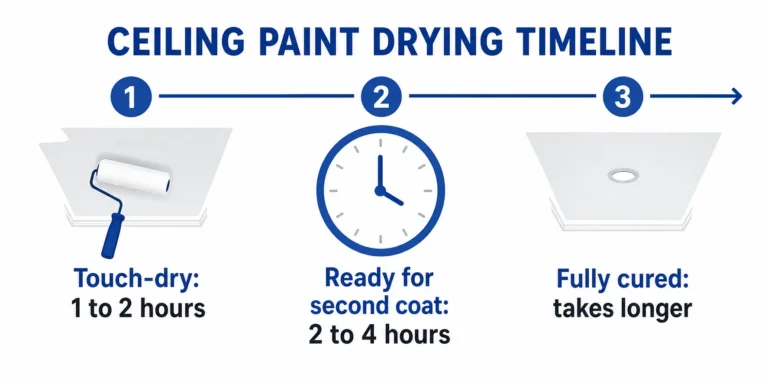
Ceilings painted with interior latex or acrylic water-based paint will dry rather quickly at room temperature. A single thin, level coat can be touch-dry in approximately 1 to 2 hours; however, being touch-dry doesn’t necessarily mean the ceiling is ready to work on.
The second coat may take additional time. The timing can depend on the manufacturer’s suggested period and the area the paint is used in, but for the most part, water-based paints take 2-4 hours before you can put on a second coat (while some known paints call for a far longer period). Check the label; it may vary.
Drying Time vs. Curing Time
Drying is the first step in the paint application process and usually means the removal of water or other volatile ingredients from the coating. Curing is a general term used to describe the process by which a coating finally reaches the desired hardness and durability.
The ceiling could feel completely dry, but the paint beneath may still be curing. Throughout this phase, far too much rubbing, cleaning, contact, or moisture may mar the finish. It’s also best to allow time for the paint to cure so the new coating can perform to its full potential.
What Factors Affect Ceiling Paint Drying Time?
No matter how wet the ceiling paint coat looks, the surrounding conditions as well as how the paint is applied play a vital role in how fast the paint loses its moisture and therefore dries out. The paint used makes a difference too.
Temperature and Humidity
The temperature can influence drying significantly. Paint is usually more adaptable if applied within the range of temperature advised by the supplier. If the room temperature is very cold, this can cause a deceleration in evaporation and a longer period for the coating to dry. Depending on humidity conditions, it can also help to warm up and dry out the room, as moisture in the air hampers the ability of water-based paint to release its own moisture. A warm, dry room with adequate air movement is a happier environment than a cold, damp one.
Ventilation and Airflow
Good air movement helps excess moisture to evaporate from the painted surface. Open windows, fans, and improved circulation of air may be beneficial in certain rooms and environmental conditions, but they should be used with care.
Air movement should not be aimed directly at the freshly painted surface, as this may cause the paint to dry unevenly or dust to be blown onto the wet film. Ventilation is especially important in rooms where there is little exchange of air. This is not about rushing the drying of the paint but about creating stable conditions for normal drying.
Paint Thickness and Application Method
You might think slopping on a thick coat of paint will have you finishing your ceilings in no time, but it has the opposite effect. Thick coats of paint stay soft underneath while the paint on the exterior dries. Proper roller selection and applying reasonably thin coats with a roller prevent uneven drying.
Professional painters also know exactly how much paint to load on a roller and how to maintain consistent application to prevent brush marks, lumps, and uneven coating across the whole surface.
How Long Should You Wait Between Ceiling Paint Coats?
Arguably the second most vital question about timings while working on a ceiling is how long one should wait before applying the next coat. How much time does your ceiling paint need to dry before the next layer can be applied? This can commonly be anything between 2 and 4 hours for a lot of water-based ceiling paints.
Applying an additional coat prematurely may cause streaks or roller marks due to disturbance of the previous layer with the roller. It may also impede roller movement if a partially dried coat is disturbed by the roller. Premature recoating may lead to a delayed drying time.
Signs the First Coat Is Ready
The safest guidance is to use the time recommended for recoating by the paint manufacturer, not just visual checks. The surface should usually feel dry and hard and not tacky or soft.
Touch a small, hidden area where it will not cause any harm, and if the coating feels sticky or transfers paint to your finger, it is still not ready. If an apparently smooth ceiling is still soft to the touch, it should not be recoated just to save a few minutes of work.
Common Problems Caused by Rushing the Process
Moving too quickly from one coat to another is one of the most common causes of preventable finishing problems. When you apply the second coat, the first may be disrupted, causing overlap lines, uneven sheen, or roller marks where the paint has begun to dry.
Premature taping can also pull up new paint from the ceiling or cause bleeding and ragged edges. Giving every step proper time usually saves more time than working in haste and then fixing the finish.
How Can You Help Ceiling Paint Dry More Efficiently?
You will not be able to avoid the drying time completely, but you can take some measures to facilitate uniform drying of the paint. It is indispensable to keep a comfortable room temperature, which is possible by controlling high humidity and ventilation.
Do not start painting a room that is very cold, humid, or not well ventilated unless the paint is made for such conditions. Also, good preparation of the ceiling before starting to paint will have a good impact on the project.
Use the Right Conditions
Ensure the ceiling is clean, dry, and ready to paint. Filling cracks or replacing broken panels and allowing fillers to dry before painting may avoid further delays caused by damp-related problems.
Once applied, the room should be kept at a comfortable temperature and open to the air if possible. Fans can be used to circulate the air but should not produce too much draught, as dust may be blown into the coating or the wet surface disturbed.
Follow the Paint Manufacturer’s Instructions
The information printed on the paint container about drying and recoating is one of the most reliable sources, as different paint products are formulated differently. Two paints of the same appearance can have different drying times.
Should You Paint a Second Coat on the Ceiling?
It is not always the case that every ceiling has to be given a second coat. It depends upon the color that is being painted on, the state of the surface, and the coverage of the color. In some cases, the first coat will be enough, while in others, it requires another one.
If the first coat appears to be patchy, transparent, or uneven once dry, a second coat might hide those problems. The trouble with applying a second coat too early is that it can cause problems rather than solve them.
When a Second Coat Is Usually Helpful
A second coat will be most beneficial when switching to a much lighter color from a darker one or if significant darkening of the existing surface has occurred. Minor coverage inconsistencies after the initial coat can also be evened out.
The first coat should be left to dry to the recoat stage as instructed before applying the second coat. Applying the second coat evenly and using a uniform roller technique may improve the smoothness of the completed texture.
Conclusion
The natural drying time for your ceiling paint before you apply the next coat isn’t always well established, which can make it hard to know exactly how long to wait before you hurry the job. Although many water-based paints dry and also appear dry in just a couple of hours, they take longer to adhere and to fully cure.
Looking for reliable results in interior painting and wanting to avoid uneven coverage and rushed drying? Let SD Custom Painting take care of the professional interior painting and thorough ceiling preparation. With adequate ceiling painting, you will achieve a fresh look for your ceiling with a durable and uniform finish.
FAQs
If the ceiling is a bit sticky, can I put a second coat on?
Unless you are very certain, it is probably best to wait. An excessively sticky surface may also suggest that the previous layer hasn’t quite dried and should not be repainted over. Repainting too soon may disturb the first coat and result in an uneven finish.
Will ceiling paint dry quicker in the summer?
Could it dry faster if the room was warm? Not always. Warmth can help to accelerate the drying, but most water-based paints and coatings will be hindered by a humid environment. So, a fairly warm room with sufficient airflow and reasonable humidity will usually work better than just a warm room.
What is the timeframe for cleaning a painted ceiling after painting?
You should not wash or scrub a finish that has not had proper time to cure. The sooner you wash, the more you risk damaging the paint, so allow it time to cure; most products need a certain amount of time before you can clean the paint.
Is ceiling paint the same as wall paint?
Most ceiling paints are designed to level to a low-sheen or flat sheen that helps to conceal imperfections. Others include features for overhead application. While some wall paints may be suitable for ceilings, the ideal paint for the job is often project-specific.