

Applying a coat of paint to a ceiling can transform a room, but estimating the amount of paint needed isn’t always as easy as grabbing a gallon and beginning to paint. Using too little results in an incomplete painting project, while choosing too much is costly and results in a can of unused paint.
You might have asked yourself at this point – how much ceiling paint do I need – and the simplest answer is as follows: ceiling size, the paint you select, the number of coats, and the absorption rate of the ceiling will determine the quantity of ceiling paint you will need. Fortunately, you can always calculate these quantities easily!
Table of Contents
ToggleLearn how to estimate ceiling paint, why you might run out, and how to prevent common mistakes in this tutorial for estimating ceiling paint.
What Determines How Much Ceiling Paint You Need?
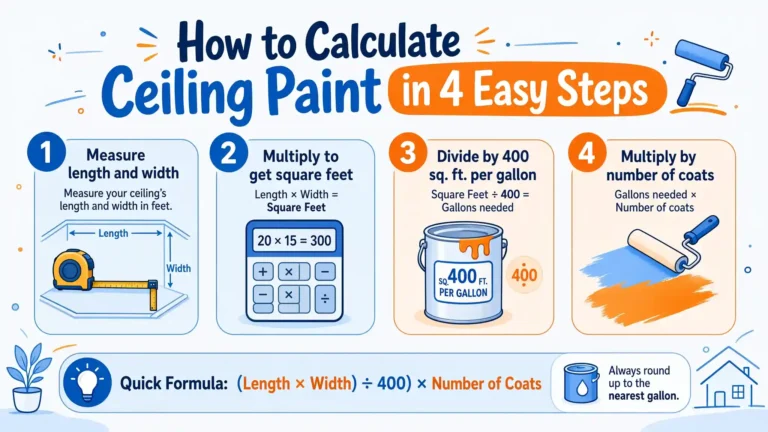
The simplest way to figure out the area of a ceiling that’s just a rectangular shape is to measure out the room’s length and multiply it by the width. For example, a 12-by-10 room has a ceiling that’s 120 square feet.
But surface area is just the beginning. Paint coverage also depends on the type of paint used, with 350 to 400 square feet being a common median estimate for a gallon of interior ceiling paint in normal circumstances. A ceiling with high texture or high porosity could require additional paint.
How Much Paint Is Needed for Different Ceiling Sizes?
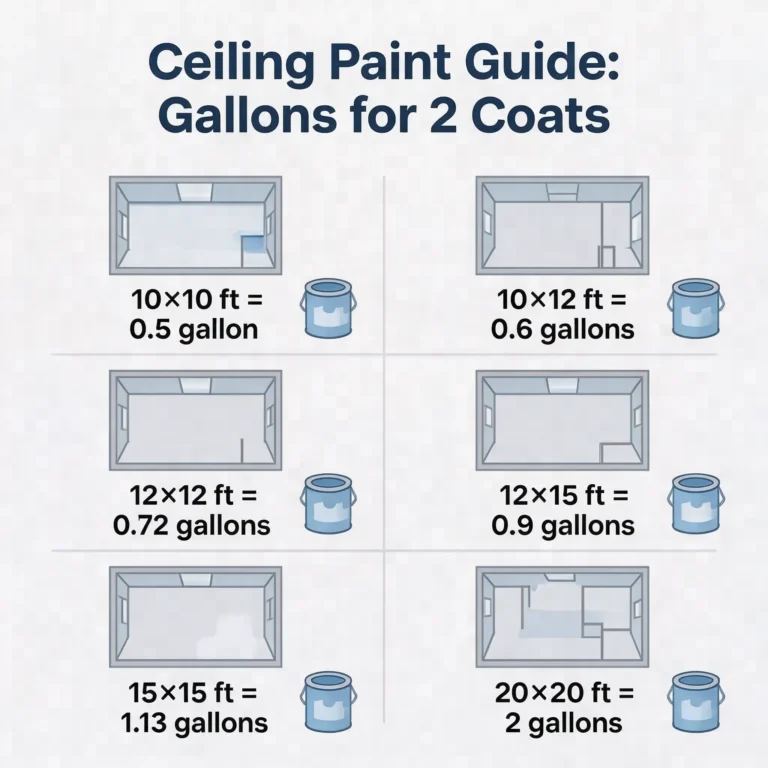
Calculating paint becomes quite straightforward after working out the formula for it in rooms of various sizes. The following examples are based on roughly 400 sq. ft. per gallon, for two coats.
Ceiling Size | Ceiling Area | Approx. Paint for 2 Coats |
10 × 10 ft | 100 sq. ft. | 0.5 gallon |
10 × 12 ft | 120 sq. ft. | 0.6 gallons |
12 × 12 ft | 144 sq. ft. | 0.72 gallons |
12 × 15 ft | 180 sq. ft. | 0.9 gallons |
15 × 15 ft | 225 sq. ft. | 1.13 gallons |
20 × 20 ft | 400 sq. ft. | 2 gallons |
These figures are to be used as a guide when planning your painting projects. They cannot substitute for the coverage information on your individual paint can. Certain products cover more or less in accordance with their formulation and the surface to be painted.
If you have many rooms on your ceiling, find the area of each room and then add them together. This should be more reliable than estimating the whole house from memory.
How to Know How Much Paint You Need for Textured Ceilings
Why do textured ceilings take more paint? Textured ceiling finishes have more surface area and so appear to use more paint. A textured ceiling surface will be more difficult to paint evenly.
If the ceiling has popcorn, heavy stippling, or other heavy finish, you may want to buy more paint than your guesstimation. A roller has a tougher time working into the corners and crevices of a bumpy surface. If your home was built before the 1980s, have a popcorn ceiling tested for asbestos before scraping or sanding it.
The condition of the texture matters as well. Older or very absorbent ceilings can drink in the paint, particularly early in the can. A good primer can help on some surfaces by sealing them before the finish coat.
Plan for Porous or Patched Areas
Paint sheen can look uneven over drywall patches, joint compound, water stains, or areas where the drywall paper has been torn, because these spots absorb paint differently from the rest of the ceiling.
Priming repaired areas before ceiling paint can reduce uneven absorption. If the whole ceiling has irregular porosity, priming the entire ceiling could be an option. For homes built before 1978, follow the EPA’s lead-safe work practices when sanding or scraping old paint.
These detailing steps will also pay off in more even coverage from the finish paint, making your estimate more consistent.
How Much Ceiling Paint Will I Need for Two Coats?
Keep in mind that two coats will not necessarily result in double the paint used. The first coat might be partly absorbed into the surface, whereas the second coat will tend to be more even over the sealed area. But from the perspective of planning, two coats are the safest estimate, assuming, of course, the ceiling does indeed need two coats. It is very frustrating to buy enough paint for a coat, only to find after you’ve just finished it that you needed two.
Should You Buy Extra Ceiling Paint?
It’s OK to buy a little extra paint, but don’t go overshooting the estimate. Adding a little extra will be fine to cover small spills, roller soak-up, uneven surfaces, and additional layers. It can also be saved for touch-ups after the project is finished. Ceilings can show damage after furniture has been moved, or after areas of the ceiling have been fixed or minor repairs have been made.
How does a professional painter estimate the required amount of materials? If available, request advice from a knowledgeable contractor as to how they calculate the amount needed. A professional may consider the actual surface condition and method of application rather than the length and width of a room.
Common Mistakes When Estimating Ceiling Paint
The most common mistake is to use the floor area instead of measuring the ceiling, or to forget the extra area in irregular ceiling designs. Examples include rooms with alcoves, sloped ceilings, open spaces, or a cluster of linked rooms. One more mistake is to overlook the coverage of the selected paint. Two different brands can have different coverage rates, even on the same ceiling. To avoid this situation, it is better to read the directions from the manufacturer. It can also be tempting to think little of surface prep.
Tips for Getting Better Ceiling Paint Coverage
Preparation is quite significant in how effectively the paint is used. Remove stains, repair damage, and allow the surface to dry; remove dust and cobwebs. Choose the appropriate roller nap for the texture of your ceiling and avoid overloading the roller. Excess paint might cause runs and uneven coverage – too little means extra trips back and forth over the same areas.
Apply in sections that are easy to work in, and try to keep a wet edge when you can, as this will give a smoother finish and minimize the appearance of overlaps. Wait for the coats of paint to dry before applying an additional coat if needed, according to the manufacturer’s instructions.
Final Thoughts
Knowing how much ceiling paint you need before you buy will help you control the cost. This will help you not only save money on the project but also avoid waste and delay during the job.
First, take a measurement of the ceiling, then find the area, compare that to the coverage rate of the paint, multiply by the number of coats you will need, and then consider the condition of the ceiling. If you are wondering about measurements, preparations, selection of the products, or even about how much paint you will need, professionals can not only remove the confusion but also help you do a successful job.
If you are in San Diego and want a professional ceiling, SD Custom Painting offers professional ceiling painting services. If you are interested, then contact us.
FAQs
Can I paint the ceiling without a primer?
Primer can be beneficial when the ceiling has stains, repairs, drywall showing through, or uneven absorption. It provides a more uniform surface as well as allows the finish coat to work better.
Is ceiling paint different from wall paint?
Ceiling paint is designed for easy coverage, very little dripping, and a low sheen. Some wall paints can be applied on the ceiling, but it is easier to use a ceiling paint.
Is it OK to keep extra ceiling paint?
Extra leftover paint can sometimes be handy for repairing a small nick. But if you purchase a lot more than necessary, you can waste it and spend a lot more money, so a good estimate with a little bit of extra is the safest bet.