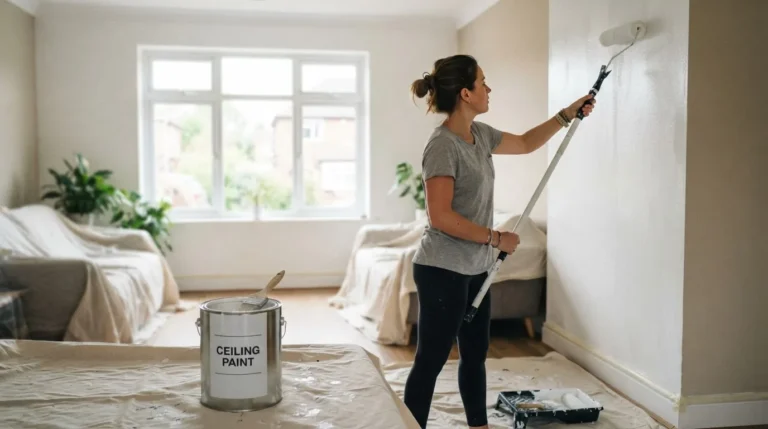

Can You Use Ceiling Paint On Walls? Yes, but it may not be ideal. Even if it’s designed and formulated specifically for application on ceilings (to reduce sheen and glare, conceal surface irregularities, and apply more evenly), you can paint it onto a wall. Ceiling paint typically has a flat finish with a sheen of less than 5 gloss units when measured at a 60-degree angle (the method described in ASTM D523), which is why it hides surface imperfections so well.
You should also consider whether it is lacking in the durability or cleanability of most other paints or if it simply may not feel as appealing to the touch as a wall paint.
So, if you have some leftover ceiling paint in a bucket, think about how the paint is going to behave on your wall, and how it will impact the wall surface before you crack open the can and paint away!
Can You Use Ceiling Paint on Walls?
Yes, but a few things to consider! Most paints you use on a ceiling will be a water-based acrylic or latex (basically a paint that you’ll find on walls), and if properly applied, prepped, and primed, the ceiling paint will adhere well to your wallboard or previous paint. If your home was built before 1978, the old paint may contain lead, so sanding or scraping it should follow the EPA’s lead-safe renovation and painting guidelines.
The last consideration to make would be the ‘finish’ of the paint; flat/matte paints (the ceiling’s default finish) are meant to hide any imperfections on a surface; you may like this look on some of your walls, though it’s not the most forgiving of finishes in high-traffic or kitchen walls.
Lastly is a question of durability; we tend to use walls more often than the ceiling and require a more durable coating that is often washable. Some ceiling paints may not be as washable as a paint you might use on a wall and, as such, are more prone to damage and marking.
What Is the Difference Between Wall and Ceiling Paint?
Paint is basically there to protect your walls and ceiling and make your home look great. But paint formulations have distinct features. Because ceiling paints apply more easily and have a lighter coating, the finish will generally appear to be smoother than a wall paint’s finish.
With a greater understanding of these features, you as a consumer will be better able to determine which type of coating is most suitable for all of your home’s interior surfaces.
1. Finish and Visuals
Flat (non-reflective paint) is the most popular type of ceiling paint, as it will hide surface imperfections better than reflective paints.
Some wall paints have varying finishes, such as flat, eggshell, satin, and semi-gloss, which can be applied to different areas of the house according to the owner’s preference and how clean they want the paint to be kept. For example, in the living room, an eggshell finish is most commonly used.
2. Robustness and Washability
Paint on your walls should be easy to clean. Your paint will need to be able to resist stains and scuffs, and to survive cleaning well – especially in your kitchen, hall, or family room.
There are different kinds of paint in relation to cleaning. There are scrub-resistant paints for your walls; there are some that can be cleaned without using very much soap at all, and then there are some that are bleached or fully washed off after having been cleaned twice or thrice, and so are not truly up to this job in every room.
3. Application and Thickness
Remember that wall paint is made to go on a wall, and ceiling paint is made to go on a ceiling.
Wall paint and ceiling paint features at a glance:
- Finish: Traditional wall paint is available in a variety of finishes, including eggshell, semi-gloss, and gloss, whereas ceiling paint is only available in either flat or matte finishes.
- Application of paint: Wall paint is for your house interior walls, and ceiling paint is for all your interior ceilings.
- How the paint reflects light: Ceiling paint is specifically designed to have minimal reflection so that imperfections are less visible, while wall paint will reflect light to different degrees depending on the finish.
- Durability: Usually, ceiling paint is not as durable as the paint used on walls, because a ceiling is rarely touched or scrubbed; still, there are many choices for ceiling paint.
- Washability: Some of the ceiling paints are not as washable as the interior wall paints. At the same time, ceiling paint is available in an eggshell finish, and there are some other options for ceiling paints for high-traffic areas.
Ceiling paint has to be formulated so that it does not tend to splatter when put on the ceiling, whereas wall paint ought to be formulated for straightforward use on vertical surfaces.
Benefits of Using Ceiling Paint on Walls
Ceiling paint on the walls gives a more matte, flat finish. If you like that flat, very non-reflective finish on the walls, ceiling paint is going to give it to you.
If the walls aren’t that great and you want to hide imperfections, ceiling paint has a flat, matte finish that conceals imperfections quite well.
A flat finish will wear well in quiet areas and in rooms where the walls do not need to be cleaned often. It might not be suitable for areas where the walls need to be cleaned frequently or require higher durability paint, however.
Potential Drawbacks to Consider
It might not have the same durability and cleanability as paint meant for walls. For instance, if a child’s dirty hand gets pressed on a wall with ceiling paint, the dirt can be wiped off; however, so can some of the paint. Ceiling paint isn’t as hard-wearing as a lot of wall paint.
As well as being less washable, some types of ceiling paint aren’t very washable at all. If you try to clean marks off a ceiling paint wall, you might remove some of the paint itself, too.
Using ceiling paint on the walls is going to result in a less reflective surface because of the flat finish of ceiling paint. Flat finishes tend to hold dirt and scuffs more readily than paint with more gloss in it.
In high-traffic homes, flat paint will look worn out and dirty more quickly. But again, this all depends on the specific type of ceiling paint you are using for the walls.
Even though there are potential disadvantages, it’s perfectly fine to use ceiling paint for wall surfaces in certain situations. It really depends on the needs of your project.
Where Can You Use Ceiling Paint Instead of Wall Paint?
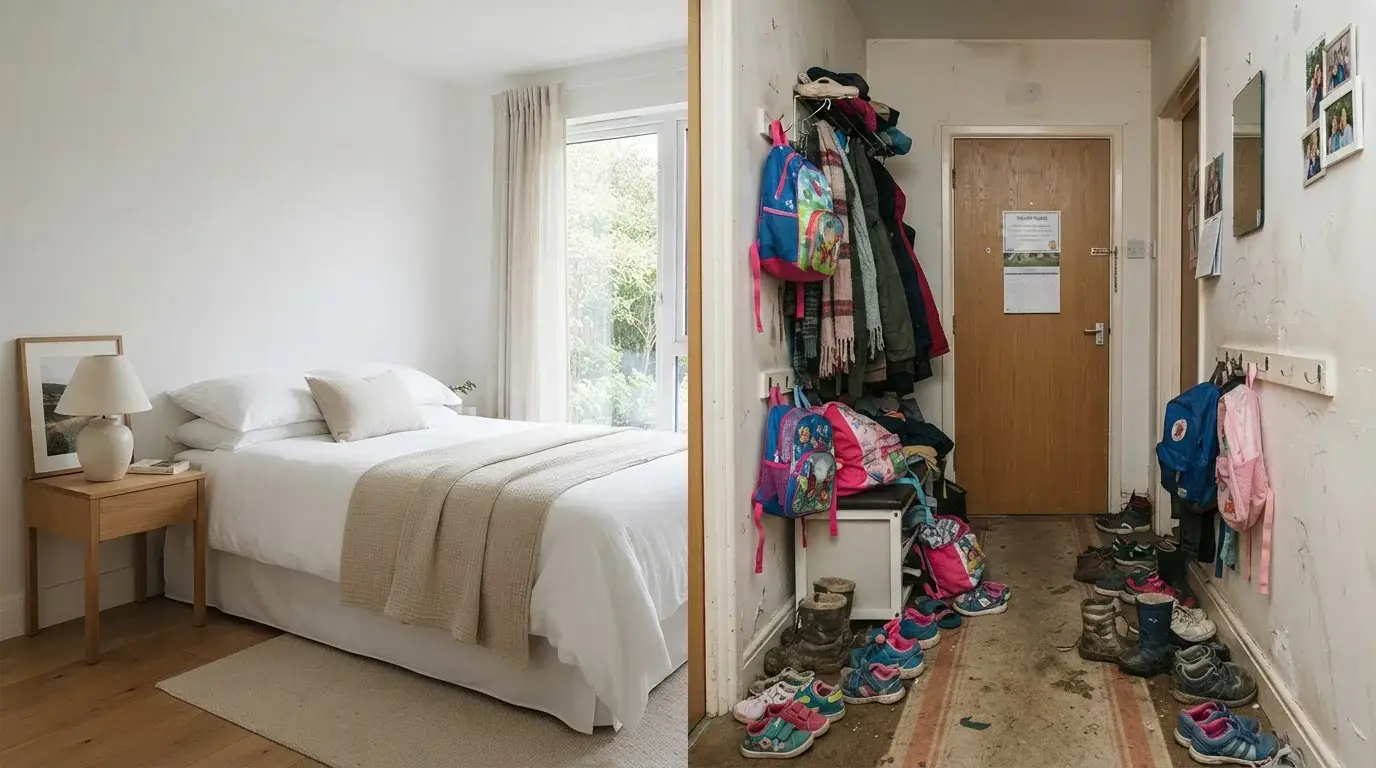
Deciding to paint interior walls with a product labeled for ceilings hinges upon the amount of use or abuse the average room in a home receives. Some rooms remain fairly pristine and rarely require washing; others need a more durable wall finish.
- Guest rooms: Generally speaking, guest bedrooms don’t see the same traffic levels as rooms used by family members. Ceiling paint can be used in guest bedrooms as long as you select the correct ceiling paint and the wall surface isn’t subject to regular washing.
- Closets and storage rooms: These small, secondary spaces are seldom subject to much traffic, which means you likely won’t see many stains or other damage. A flat finish is about all you’ll need to get the look you want at a low cost.
- Low-traffic hallways: A narrow, seldom-used hall may be able to have ceiling paint on the walls. Hallways in high-traffic areas, like entryways, hallways between rooms, and along stairwells, need a more durable product.
- Decorative accent walls: This is an especially handy way to get a totally matte, muted look. Just make sure your chosen ceiling paint is suitable for walls and can stand up to everyday life.
Don’t assume that ceiling paint is going to work in all these areas without following the suggested instructions for use.
When Should You Choose Regular Wall Paint?
Although the use of ceiling paint on walls is a good alternative in some cases, for interior home walls it’s generally better to use wall paint as it provides you with a wider selection of paint finishes and better overall paint performance.
Think about how the wall will be used – is it in a family room, hallway, kitchen, bathroom, kids’ bedroom, or other room – to assess the longevity and cleanability of the finish that you choose to apply on that wall. You will likely get a better, longer-lasting result in those areas by choosing an eggshell, satin, or other more durable paint finish, instead of ceiling paint.
Also, if the color on your wall will be changing a lot – such as painting a light color over a very dark one – then choose good interior wall paint to ensure uniform coverage. When you use wall paint, especially a quality one, it will deliver the ideal level of sheen or flatness, uniform coverage, and protection that the walls require.
If you’re in doubt about which type of paint you need, your local painting pro can look at your room’s wall surfaces, consider the lighting, take note of your needs, and then suggest the best paint and product finish for your painting project.
Final thoughts
Applying ceiling paint on walls is an option but must be done with close attention paid to paint makeup, room function, and durability requirements. A viable solution in some cases, ceiling paint might be OK for lower-traffic rooms requiring a flat finish, but a more traditional wall paint is best for rooms where regular washing will occur.
Before embarking on your next interior paint job, make sure you have done your homework and factored in the long-term requirements. For those homeowners desiring the perfect interior paint finish with none of the extra labor that results from inferior choices, contact SD Custom Painting to help assess, recommend, and produce.
FAQs
Is ceiling paint thicker than wall paint?
Ceiling paint is often formulated to be a little thicker to cut down on drips and splatter as it is applied overhead, but not all ceiling paints have a thicker consistency. Check with the manufacturer to find out if the product you are using is thicker than usual.
Can ceiling paint be used in the bedroom?
If it is acceptable to the manufacturer, it may be used on bedroom walls. A guest bedroom or a room used infrequently is a fine choice for ceiling paint. However, a bedroom for a child or a room that gets regular use would generally be better painted with an interior wall paint that has some degree of washability.
Can ceiling paint be used in the bathroom?
It should only be used on the walls of a bathroom if it is designed for that purpose. The humidity and moisture of a bathroom create an environment where some ceiling paints and many other types of paint will peel. The EPA recommends keeping indoor humidity between 30 and 50 percent to help prevent mold, and a bathroom can easily rise above that range after a hot shower.
Will ceiling paint need more coats to cover walls?
Not necessarily. It depends on the paint, the surface, how it’s applied, and how different the colors are. Some ceiling paints cover well; others don’t. A gallon of paint typically covers about 350 to 400 square feet with one coat, so a standard 12-by-12-foot room with 8-foot ceilings needs roughly one gallon per coat for its walls.
Is ceiling paint cheaper than wall paint?
Ceiling paint is sometimes less expensive than wall paint. If you have a small project and some leftover ceiling paint, it may be tempting to save money and use it on the walls, but if the paint isn’t right for the room, you may find yourself paying for repainting.