
Is it safe to sleep in a freshly painted room the same day you paint it? No, not usually. Fresh paint releases fumes called VOCs, and breathing them all night is not worth the risk.
The good news is you don’t have to guess. Below you’ll find exact wait times by paint type, what to do if you don’t know which paint was used, and when the risk actually matters.
Table of Contents
Toggle
What's Actually in That Paint Smell
That smell isn’t just “paint.” It’s volatile organic compounds, or VOCs, leaving the wet paint and entering the air you breathe. VOCs are the solvents that keep paint liquid inside the can.
The moment you roll paint onto a wall, those solvents start to evaporate. That process is called off-gassing, and it’s the entire source of the smell.
Most VOCs are just an irritant. A few, like benzene and formaldehyde, show up in older or heavier paint formulas and carry real health risks with repeated exposure. You don’t need to memorize the chemistry. You need one rule: the stronger the smell, the more VOCs are still in the air.
Here’s the part most people get wrong. A wall can feel bone dry within a couple hours and still be releasing VOCs. Dry and cured are not the same thing. A wall can look done after two hours but keep releasing fumes for days, just at a lower level you may not notice. This one fact is why so many people ask if it’s safe to sleep in a room after painting, even when the walls look finished.
You can read more about VOC health effects directly from the EPA’s page on volatile organic compounds.
How Long After Painting Can You Sleep in the Room?
This is the real question, so here’s the direct answer by paint type.
- Water-based (latex or acrylic) paint. This covers most walls painted today. It dries to the touch in one to four hours and clears out fast with airflow. Sleeping in the room after painting is usually fine at the 24-hour mark for a healthy adult. Wait longer if the room has no fresh air moving through it.
- Oil-based paint. Rare on walls now, but still common on trim, doors, and cabinets. It off-gases slower and stronger than latex. Wait 48 to 72 hours before sleeping in that room. Don’t rush this one.
- Low-VOC or zero-VOC paint. This is the lowest-fume option on the market, and what we recommend for bedrooms and nurseries. With a window cracked and a fan running, some people sleep in the room the same night. We’d still give it 6 to 12 hours at minimum, just to clear any lingering odor.
- Primer. Shellac-based primer smells strong but clears fast, often within 24 hours. Oil-based primer behaves like oil-based paint and needs the full 48 to 72 hours.
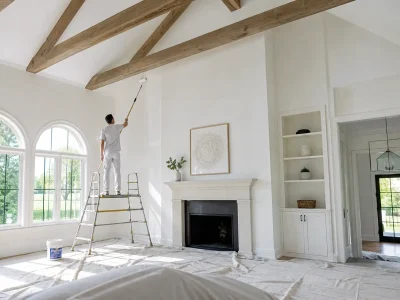
- Ceiling paint versus wall paint. Fumes rise, so a freshly painted ceiling sits directly above where you breathe all night. If you painted the ceiling, add extra time before sleeping under it, even if the walls were done days earlier.
- Sprayed paint versus rolled or brushed paint. Spraying breaks paint into fine airborne particles, which puts far more VOCs into the room air than rolling or brushing does. If a room was spray painted, treat it like the more cautious end of the wait times above.
Quick Reference: Sleeping in a Room After Painting
Paint Type | Dry to Touch | Safe to Sleep (Ventilated) | Safe to Sleep (Poor Ventilation) |
Water-based / Latex | 1–4 hours | ~24 hours | 48 hours |
Low-VOC / Zero-VOC | 1–2 hours | 6–12 hours | 24 hours |
Oil-based | 6–24 hours | 48–72 hours | 4+ days |
Shellac-based primer | 30–45 minutes | 24 hours | 48 hours |
Oil-based primer | 24 hours | 48–72 hours | 4+ days |
Sprayed paint (any type) | Varies | Add 12–24 hours to the row above | Add 24+ hours to the row above |
If you don’t know which paint went on the walls, treat it like oil-based paint and wait the full 48 to 72 hours. It’s better to overshoot than guess wrong.
What If You Don't Know Which Paint Was Used?
This happens more than you’d think, especially in rentals or homes you just bought. Here’s how to find out before you guess.
Check the garage, closet, or utility room for a leftover paint can. The label lists the paint type and brand right on the front. If you can’t find a can, look for a receipt from a home improvement store or the contractor’s invoice.
Still no answer? Ask your landlord, property manager, or whoever hired the painter. If none of that works, check the sheen. Oil-based paint usually has a slightly plastic-like shine and a stronger, sharper smell than latex. When you genuinely can’t tell, default to the oil-based timeline of 48 to 72 hours. That’s the safer assumption either way.
Can You Die From Sleeping in a Freshly Painted Room?
Let’s be direct, since this question comes up a lot. No, sleeping in a freshly painted room will not kill a healthy adult in one night. Fatal outcomes from paint fumes are extremely rare and almost always tied to industrial solvents in a sealed, unventilated space over long exposure, not a normal bedroom with standard latex paint.
That said, “won’t kill you” isn’t the same as “harmless.” Real, documented risks from sleeping in a painted room too soon include:
- Headaches and lightheadedness from concentrated VOC exposure
- Nausea, or irritation in the throat and eyes
- Worse symptoms for anyone with asthma or a chemical sensitivity
- Poor sleep quality from a lingering smell, even at low levels
Some people need more caution than the “healthy adult” rule allows. Infants, pregnant women, older adults, and anyone with a respiratory condition should add a full extra day to whatever timeline applies to their paint type. No exceptions.
What about pets?
Dogs and cats are closer to the floor, where heavier VOC particles tend to settle. They also can’t tell you they feel sick. Keep pets out of a freshly painted room for the same amount of time you’d keep a baby out of it, and watch for signs like unusual lethargy, coughing, or refusing food after they’re allowed back in.
How to Speed Up Off-Gassing
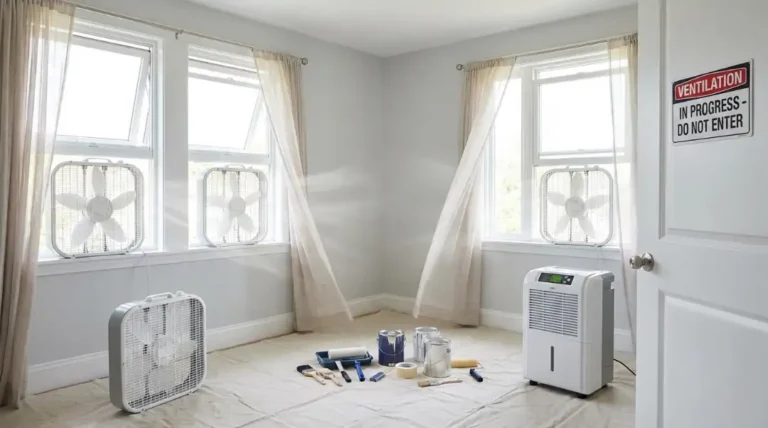
You can cut these wait times down with the right setup. Here’s the routine painters actually use on real jobs.
- Open two windows on opposite walls, or a window and a door, to create true cross airflow.
- Point a box fan out of the window, pulling air from the room to the outside, instead of pushing outside air in.
- Run your HVAC fan on continuous circulation with a clean filter, if your system pulls in fresh outside air.
- Keep the door to the rest of the house closed while the room airs out, so fumes don’t spread to other rooms.
- Use a HEPA air purifier with an activated carbon layer. A standard HEPA filter alone won’t catch gas-phase VOCs.
- Skip space heaters near fresh paint. Heat speeds curing but can also raise fume concentration in a closed room.
Doing all of the above genuinely helps clear a room faster than doing nothing, though the exact time saved depends on room size, outdoor temperature, and how much paint was applied. Treat these steps as the floor, not a shortcut around the wait times above.
Can’t ventilate the room?
If it’s too cold to open windows, or the room has no working windows at all, don’t sleep there on the original timeline. Instead, run an air purifier with a carbon filter continuously for a few extra days, keep the door shut, and check the room daily by opening the door and smelling the air before deciding it’s ready. A VOC or air quality meter, sold at most hardware stores, can also give you a real reading instead of relying on your nose.
Myth vs. Fact: Paint Fume Safety
Myth: A little paint smell means the fumes are working their way out, not doing any harm.
Fact: Smell is not a safety gauge. Some VOCs are odorless even at levels that irritate your airway. Some low-odor paints still release measurable VOCs.
Myth: One open window is enough ventilation.
Fact: A single window creates almost no real airflow. You need true cross ventilation, air entering one side of the room and leaving another, to actually clear fumes out.
Myth: Zero-VOC paint means zero fumes.
Fact: “Zero-VOC” is a legal labeling threshold, generally under 5 grams per liter, not a literal absence of every compound. Zero-VOC paint is still the safest option available, but it can carry a faint smell from other additives like colorants.
San Diego Ventilation Considerations
San Diego’s mild year-round weather works in your favor here. Unlike colder regions where windows stay shut most of the winter, San Diego rarely gets cold enough to rule out cross-ventilation, even in December or January.
That means most San Diego homes can hit the ventilated wait times in the table above almost any time of year. If you’re painting during a rare cold snap or a Santa Ana wind event with poor air quality outside, lean toward the poor-ventilation timeline instead and wait it out.
Named Low-VOC Standards Worth Knowing
If you want a paint that’s genuinely low in fumes, look for the Greenguard Gold certification on the can or the manufacturer’s spec sheet. This certification tests for chemical emissions and sets stricter limits than the basic “low-VOC” label alone, which makes it a more reliable signal than marketing language on its own.
A paint labeled “low-VOC” without any certification behind it can still vary a lot between brands. Certification matters more than the phrase on the label.
The Bottom Line
Sleeping in a painted room comes down to three things: what paint went on the wall, how much airflow the room got, and who’s sleeping in it. Latex and low-VOC paints clear fast with real ventilation. Oil-based paint needs patience: 48 to 72 hours- no shortcuts. If a baby, a pregnant partner, a pet, or anyone with breathing issues will use that room, add extra time before you second-guess it.
Treat ventilation as half the job, not an afterthought. Combine the right paint with real airflow, and most bedrooms are safe to sleep in well within a couple of days.
If you’d rather skip the guesswork, that’s exactly what our crews handle on every job. San Diego Custom Painting uses low-VOC and zero-VOC paint as standard on bedrooms and nurseries, and we walk every client through a room-specific ventilation plan before we leave the job site. If you’re looking into interior painting services in San Diego and want a crew that treats indoor air quality as part of the job, not an afterthought, get in touch and we’ll build the plan around your home.
FAQs: Sleeping in a Painted Room
Is it safe to sleep in a room after painting the same day?
Only with zero-VOC paint and strong ventilation running the whole time. Even then, if you can still smell paint, sleep somewhere else that night.
How long after painting can I sleep in the room if I used latex paint?
Around 24 hours with good airflow. Extend that to 48 hours if the room has no cross ventilation or the coat was heavy.
Can paint fumes hurt a baby while sleeping?
Yes, infants are more sensitive to airborne chemicals than adults. Wait at least 48 hours after latex paint and 72 hours after oil-based paint before a baby sleeps in that room.
Does the paint smell going away mean it’s safe now?
Not fully. Odor fades faster than VOC levels actually drop. Use the timeframes in the table above as your real guide, not your nose.
What symptoms mean I should leave the room immediately?
Headache, dizziness, nausea, or burning eyes and throat. Leave, ventilate the room further, and don’t go back until the symptoms are gone and the room has aired out longer.
Is oil-based or water-based paint safer for a bedroom?
Water-based, or latex, paint is safer for bedrooms. It carries far fewer VOCs and clears out faster than oil-based paint, which is why most bedroom walls today use latex or acrylic formulas.
Is it safe for pets to sleep in a freshly painted room?
No, keep pets out on the same timeline you’d use for a baby. They sit closer to the floor where fumes settle, and they can’t tell you if they feel sick.
Can I run an air purifier overnight instead of waiting the full time?
An air purifier with a carbon filter helps, but it doesn’t replace the wait time. Use it alongside the timelines above, not as a way to skip them.
Does painting just the ceiling change how long I should wait?
Yes. Fumes rise, so a freshly painted ceiling sits right above where you breathe all night. Give it extra time compared to a wall-only paint job.