
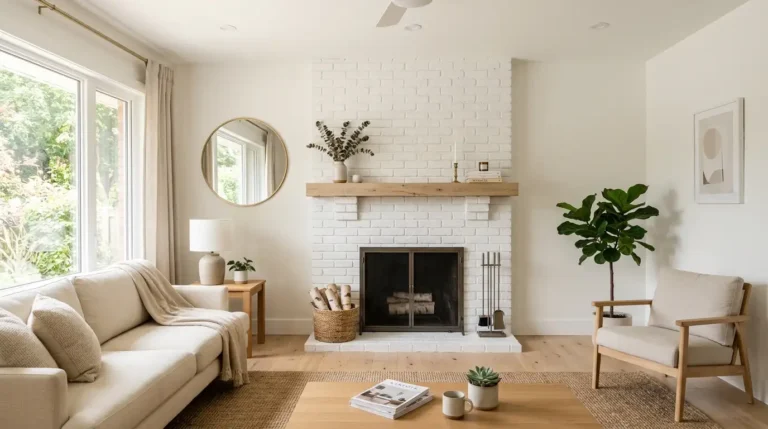
If your old red brick fireplace looks dark, dated, or out of place, a fresh coat of paint can completely transform your room. Taking on a DIY masonry project like this can feel intimidating, but you can achieve a flawless, modern finish with the right tools and proper preparation.
Learning how to paint a brick fireplace requires a clear understanding of porous surfaces, specialized cleaning steps, and heat ratings. This comprehensive guide walks you through every stage of the process, from deep cleaning soot stains to choosing a long-lasting, heat-safe topcoat.
Table of Contents
ToggleIs It Actually a Good Idea to Paint a Brick Fireplace?
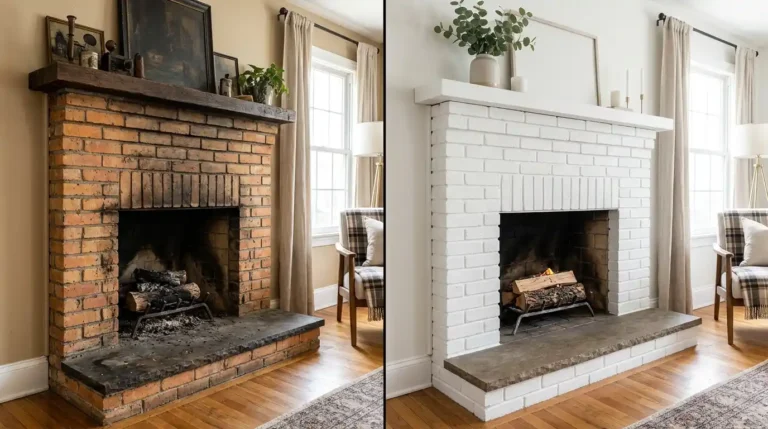
Short answer: usually, yes. Painting a brick fireplace is one of the highest-impact, lowest-cost updates you can make to a living room. It brightens a dark corner, unifies a mismatched color scheme, and makes a dated 1980s or 1990s fireplace look intentional again.
There’s one caveat worth saying up front, because none of the big paint brands will tell you this part: paint is permanent. Once you paint brick, you cannot realistically strip it back to bare masonry. If you love the idea of exposed brick down the road, or you’re in a historic home where original masonry adds resale value, sit with that decision for a week before you commit. Everyone else goes ahead.
Real estate agents in most markets report that a clean, neutral painted brick fireplace photographs better and shows better than raw red brick, especially in homes built before 2000. It’s one of the few paint projects that tends to help resale rather than just personal enjoyment.
What You'll Need Before You Start
You don’t need a truckload of supplies for this, but skipping any of these items is exactly how a paint job fails within a year.
- Stiff wire brush (for scrubbing loose mortar and old soot)
- Shop vacuum with a brush attachment
- TSP (trisodium phosphate) or a degreasing masonry cleaner
- Sponges and clean rags
- Painter’s tape and heavy drop cloths
- Angled sash brush, 2–2.5 inch, for mortar lines and edges
- Thick-nap roller cover, 3/8″ to 1/2″, for the textured brick face
- Roller extension pole if the fireplace runs floor-to-ceiling
- Masonry bonding primer (not a standard wall primer — more on this below)
- Interior acrylic paint in your chosen sheen
- Heat-resistant paint, only if you’re painting inside the firebox
- N95 mask, safety glasses, gloves
Step-by-Step: How to Paint a Brick Fireplace
Step 1: Clean the Brick Like You Mean It
Brick fireplaces collect decades of soot, smoke residue, and dust deep in the pores of the masonry, not just on the surface. If you skip this step, that residue will bleed straight through your new paint within weeks. Painters call it “ghosting,” and it’s the number one callback we get on fireplace jobs.
Mix TSP with warm water per the label, and scrub the entire surface with a stiff brush, working the solution into every mortar joint. Rinse with clean water and a sponge. For fireplaces with heavy soot staining, go over it a second time with a stronger degreaser concentration.
Let the brick dry fully before moving on. Brick is porous and holds moisture, so give it a full 24 to 48 hours in a well-ventilated room, longer if humidity is high.
Step 2: Inspect and Repair the Mortar
Run your hand along every mortar joint. Any joint that’s crumbling, cracked, or recessed more than an eighth of an inch needs repointing with mortar repair compound before you prime. Paint will bridge small hairline cracks fine, but it will not hide structural gaps, and it definitely won’t fix them.
Step 3: Tape Off and Protect the Area
Tape the edges where brick meets drywall, the mantel, the hearth floor, and any trim. Lay drop cloths generously rolling primer onto textured brick throws more splatter than a flat wall ever will.
Step 4: Prime with a Real Masonry Bonding Primer
This is the step almost every DIY blog glosses over, and it’s the one that determines whether your paint job lasts five years or five months.
Standard interior primer is built to seal drywall, not to grip porous, alkaline masonry. Use a high-quality acrylic masonry bonding primer, applied with a brush into every mortar line first, then rolled onto the brick face. Porous, unpainted brick usually needs two coats of primer, especially if you’re going from a dark brick to a light or white finish and want to block staining from showing through.
Let the primer cure fully overnight at minimum before painting.
Step 5: Apply Your Paint
Cut in the mortar lines and edges with a brush, then roll the field of the brick with your thick-nap roller, working in small sections so you can back-roll into the mortar joints before the edges dry. Two coats of paint is standard for full, even coverage on brick; budget for a third if you’re going from a saturated red brick to a pale or white color.
Step 6: Decide on the Mantel and Trim
If your mantel is wood trim, it typically gets a semi-gloss or satin finish in either a matching or contrasting color. A matching mantel and brick color reads modern and streamlined. A contrasting black or stained wood mantel against white-painted brick is one of the most requested looks we get from clients right now.
You may also want to read this post:
Painting Over Brick Fireplace Surfaces: What's Different From Painting a Wall
Painting over a brick fireplace isn’t just “painting a rougher wall.” Three things separate it from drywall work:
- Absorption rate. Brick soaks up primer and paint at a much higher rate than drywall, which means your material estimates need to go up by roughly 30 to 40 percent.
- Texture and coverage. The mortar recesses and brick face sit at different depths, so a thin-nap roller leaves gaps. A thicker nap pushes paint into the texture properly.
- Efflorescence. Brick can push mineral salts to the surface over time, especially in humid climates or near chimneys with moisture issues. If you see a white, powdery bloom on the brick before you start, that needs to be addressed and the moisture source identified painting over active efflorescence is a guaranteed peeling failure.
Best Paint for Brick Fireplace: A Straight Comparison
Every brand claims to be “the best paint for brick fireplace” projects. Here’s how the realistic options actually stack up for a facade (non-firebox) application.
Paint Type | Best For | Durability | Approx. Cost (1 gal) | Notes |
Acrylic latex (e.g., Sherwin-Williams fireplace paint lines, Benjamin Moore Regal Select) | Most homeowners, standard makeovers | High, 8–10+ years | $55–$80 | Needs bonding primer first |
Chalk-style mineral paint | Farmhouse, textured looks | Moderate | $40–$70 | Low sheen, forgiving on rough brick |
Limewash | Old-world, soft matte texture | Moderate, needs resealing | $50–$90 | Breathable, ideal for older masonry |
German smear (mortar wash) | Rustic, partial-coverage look | High if sealed | $20–$40 (mortar-based) | Not a true paint — a mortar and water technique |
Heat-resistant spray paint | Interior firebox only | High, rated to 1200°F+ | $10–$15/can | Never use standard paint inside the firebox |
If you want a specific product recommendation, Sherwin Williams fireplace paint options in their masonry line pair reliably with their Loxon bonding primer, and it’s what we specify most often for clients who want a true matte, chalky finish without going the full limewash route.
Heat Proof Fireplace Paint: Where the Rules Change
This is the single most misunderstood part of this whole project, and it’s worth its own section.
Standard interior paint, even premium acrylic, is fine for the facade of the fireplace, the brick face you see, the mantel, the surround. It is not fine inside the firebox, the area directly exposed to flame and radiant heat.
For the firebox interior, you need heat proof fireplace paint rated for at least 1200°F, sold as high-heat or stove paint, usually in matte black or a small range of dark colors. It’s typically applied as a spray for even coverage across the rough interior surface. Skipping this distinction is how homeowners end up with peeling, smoking, off-gassing paint inside an active firebox and it’s a fire safety issue, not just a cosmetic one.
Myth vs. Fact: Painting a Brick Fireplace
Myth: You have to sand or strip brick before painting it.
Fact: Brick doesn’t get sanded like wood. A thorough wire brush and deep clean is what preps the surface sanding masonry does very little and wastes your time.
Myth: One coat of paint is enough if you use a “paint and primer in one” product.
Fact: On porous brick, especially dark brick going lighter, plan on primer plus two paint coats minimum. Two-in-one products still underperform on masonry.
Myth: Any leftover wall paint works fine on a fireplace.
Fact: Wall paint isn’t formulated to bond with alkaline masonry the way a dedicated bonding primer and masonry-rated topcoat are. It can look fine for a few months, then start flaking.
Paint Colors with Brick Fireplace Surrounds: What's Actually Working Right Now
For clients asking about paint colors with brick fireplace features nearby, three approaches dominate the requests we get:
- Warm white or off-white (matches trim, brightens dark rooms, timeless and easiest to sell if you move)
- Charcoal or matte black (bold focal point, pairs well with wood mantels and brass hardware)
- Soft greige or taupe (blends the fireplace into the wall color instead of making it a statement piece)
If your walls are already a warm neutral, match the fireplace close to that tone for a calm, cohesive room. If you want the fireplace to be the star, go two to three shades darker or lighter than the wall, not a completely different color family — that contrast tends to read as unplanned rather than intentional.
What 26 Years of Fireplace Repaints Has Taught Us
Every callback we’ve ever gotten on a painted brick fireplace traces back to one of two things: skipping the bonding primer, or painting over active moisture. Brick that feels even slightly damp to the touch, or a fireplace near a chimney with a known leak history, needs that issue fixed first. No primer or paint will hold up long-term over a moisture problem underneath it.
The other pattern we see constantly: homeowners assume a whitewashed or limewashed look is “easier” than solid paint because it’s less coverage. It’s actually harder to get even, and it’s the finish most likely to look like a mistake rather than a style choice if it’s rushed. If you’re set on that look and you’re not confident with a brush, it’s worth having a pro do a sample section first.
Get a free quote today and see what a professionally painted fireplace looks like.
Wrapping Up
Painting a brick fireplace comes down to three things done right: a real deep clean, a proper masonry bonding primer, and the correct paint for each surface regular acrylic on the facade, heat proof fireplace paint if you’re touching the firebox interior. Get those three steps right and a painted brick fireplace easily holds its finish for eight to ten years or more.
Fireplace trends keep shifting limewash and German smear techniques have gained ground over flat white in the last couple of years but the prep fundamentals in this guide don’t change with the trend cycle.
If you’d rather hand this off to someone who’s done it hundreds of times, SD Custom Painting handles brick fireplace makeovers as part of our interior painting services in San Diego, including the prep and repair work most DIY guides skip entirely. Reach out for a free estimate, or keep browsing our project gallery for color inspiration before you commit to a shade.
Frequently Asked Questions
Do you need to prime brick before painting a fireplace?
Yes. Skipping primer is the top reason painted brick fireplaces peel or let stains bleed through. Use a dedicated masonry bonding primer, not a standard interior primer, and apply two coats on porous or dark brick.
Can you paint a brick fireplace without painting the whole wall?
Yes, and it’s the most common approach. Tape off cleanly where the brick meets the wall, and consider extending the color slightly onto the adjacent trim for a more finished transition.
How long does painting a brick fireplace take?
Plan on a full weekend for an average-size fireplace: one day for cleaning, repairs, and drying time, one day for priming and two coats of paint, with drying time between coats.
What’s the best sheen for a painted brick fireplace?
Matte or eggshell keeps the natural texture of the brick and hides small imperfections. Satin or semi-gloss reflects more light and wipes clean more easily, which some homeowners prefer near a working fireplace.
Is it safe to paint inside the firebox?
Only with heat proof fireplace paint rated for high temperatures, applied to the interior firebox surfaces. Standard wall or masonry paint is not safe for direct flame exposure.
Does painting a brick fireplace hurt resale value?
Generally no, and it often helps. A clean, neutral painted fireplace tends to show better in listing photos than dated or heavily saturated original brick, particularly in homes built before 2000.